Gallery
Institution

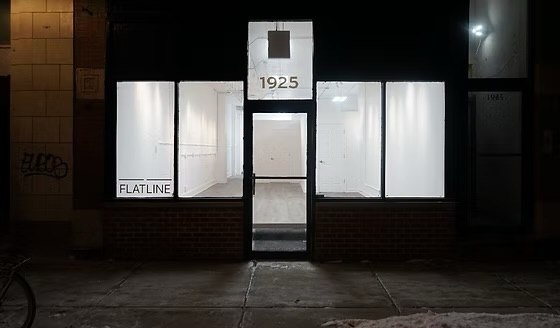
Flatline Gallery

FLATLINE is an emergent art gallery dedicated to presenting work that moves between historical inquiry and contemporary technological practice. Located inside a reconverted hair salon in Chicago’s Bucktown neighborhood, FLATLINE was founded in 2026 by friends and artistic collaborators Ben Glass and Lorenzo Osterheim. As an artist-run space, the gallery is shaped by a commitment to experimentation, critical exchange, and the development of ambitious practices that may not fit neatly within conventional institutional categories. Through rotating monthly exhibitions, FLATLINE showcases a growing network of emerging artists working across disciplines, geographies, and forms. The program places contemporary art in conversation with technology, media history, philosophy, material culture, and the changing conditions of everyday life. Rather than treating exhibitions as isolated events, FLATLINE approaches each project as a point of departure for sustained discussion, collaboration, and further research. Alongside its exhibition program, FLATLINE hosts recurring artist talks, screenings, writing groups, research groups, lectures, readings, and other collective experiments in cultural production. FLATLINE functions as a cultural relay: a site where historical materials encounter emerging technical systems, where obsolete forms return under altered conditions, and where artistic practices become entangled with wider networks of thought and production. Moving between exhibition space, research cell, screening room, and social infrastructure, the gallery aims to cultivate forms of collective attention adequate to an unstable present. Its mission is to support emerging voices while constructing new circuits between Chicago and an international field of artists, thinkers, and cultural operators.

“The flatline is where everything happens.” — Mark Fisher

About Flatline Gallery
Death by Landscape

September 4 – 25, 2026

Death by Landscape brings together nine artists working across painting, sculpture, and kinetic systems to consider nature not as an exterior realm, but as a condition already inseparable from the technological, industrial, and human systems that attempt to contain it. The exhibition approaches ecology after the presumed distinction between the natural and the artificial has begun to collapse: nature as sustained collapse, as entropic runaway, as something that exceeds every boundary imposed upon it. Preservation, extraction, contamination, extinction, infrastructure, and wilderness no longer occupy discrete territories; they have become mutually constitutive. The landscape is not a passive surface upon which these processes take place, but a record of their accumulation. Rather than mourning the disappearance of some pristine nature that preceded human intervention, the works in the exhibition inhabit a post-natural ecology in which intervention has become an environmental condition. Ruin does not interrupt nature; it enters into its composition. Under contemporary conditions, a burning oil tanker in the Strait of Hormuz becomes as natural as two dead stags, antlers locked together, buried in a waste of winter snow. Both belong to the landscape. Neither sits outside it. Nature persists not as purity or equilibrium, but as the unstable field in which catastrophe, adaptation, decay, and continuation become increasingly difficult to distinguish.

Read more →

On view
Events
Map